Blog
•
VC Fund Operations Tech Stack: 20+ Tools to Run the Back Office

Behind every top-decile fund lies a less glamorous but equally critical reality: operational excellence.
As funds scale from first-time $15M vehicles to multi-hundred-million-dollar platforms, the gap between investment prowess and operational infrastructure is a defining differentiator.
Historically, many VC firms operated with a patchwork “Frankenstein” tech stack. You got a CRM for deals here, scattered spreadsheets for portfolio tracking there, a separate fund accounting tool, and manual processes for LP reporting.
This fragmented approach may have worked for small partnerships, but today’s institutional LPs expect timely, transparent, and audit-ready reporting. Regulatory requirements continue to tighten. Capital flows are more complex. And the cost of fragmented systems—manual reconciliation, delayed reports, data inconsistencies, and compliance gaps—has never been higher.
Why Fund Operations Matter in VC
Strong fund Ops can create compounding returns for the business: faster capital deployment, better portfolio visibility, quicker response to LP requests, and the credibility that helps emerging managers stand out during fundraising.
At a time when regulatory scrutiny is intensifying, and most funds are delivering similar investment strategies, operational maturity often becomes the tiebreaker that separates good firms from truly institutional ones.
Build LP trust and retention: Consistent, transparent, and professional reporting encourages re-ups and strengthens relationships.
Reduce risk and ensure compliance: Accurate accounting, audit trails, and regulatory adherence protect the firm in an increasingly scrutinized environment.
Enable scalability: Efficient systems allow small teams to manage larger portfolios and more complex structures without proportional headcount growth.
Improve decision-making: Real-time visibility into capital calls, distributions, portfolio performance, and fund-level metrics leads to better capital allocation and governance.
Create competitive advantage: Operational maturity signals institutional quality during fundraising and helps differentiate funds with similar investment theses.
Unlock efficiency and focus: Automation frees GPs and teams to spend more time on sourcing, investing, and supporting founders.
Weak operations don’t just waste time; they create real risk, erode LP confidence, and limit a firm’s ability to scale. This is where a thoughtfully curated fund Ops tech stack makes the difference. It delivers a single source of truth, automates repetitive work, reduces errors, and frees GPs to focus on what matters most: investing and supporting founders.
So if you’re an emerging manager or scaling GP building (or upgrading) your operational foundation, start here.
The best VC fund operations tools in 2026
Carta & Juniper Square for an all-in-one fund operating system
Sydecar for launching SPVs in a day
Passthrough for investor onboarding, KYC/AML, and capital calls
Allvue Systems for institutional-grade fund accounting and LP reporting
PortfolioIQ for AI-powered portfolio monitoring
73 Strings for automated valuations and NAV
ComplyAdvantage for AML and sanctions screening
Ansarada for secure LP data rooms
Deel for hiring and paying a global team
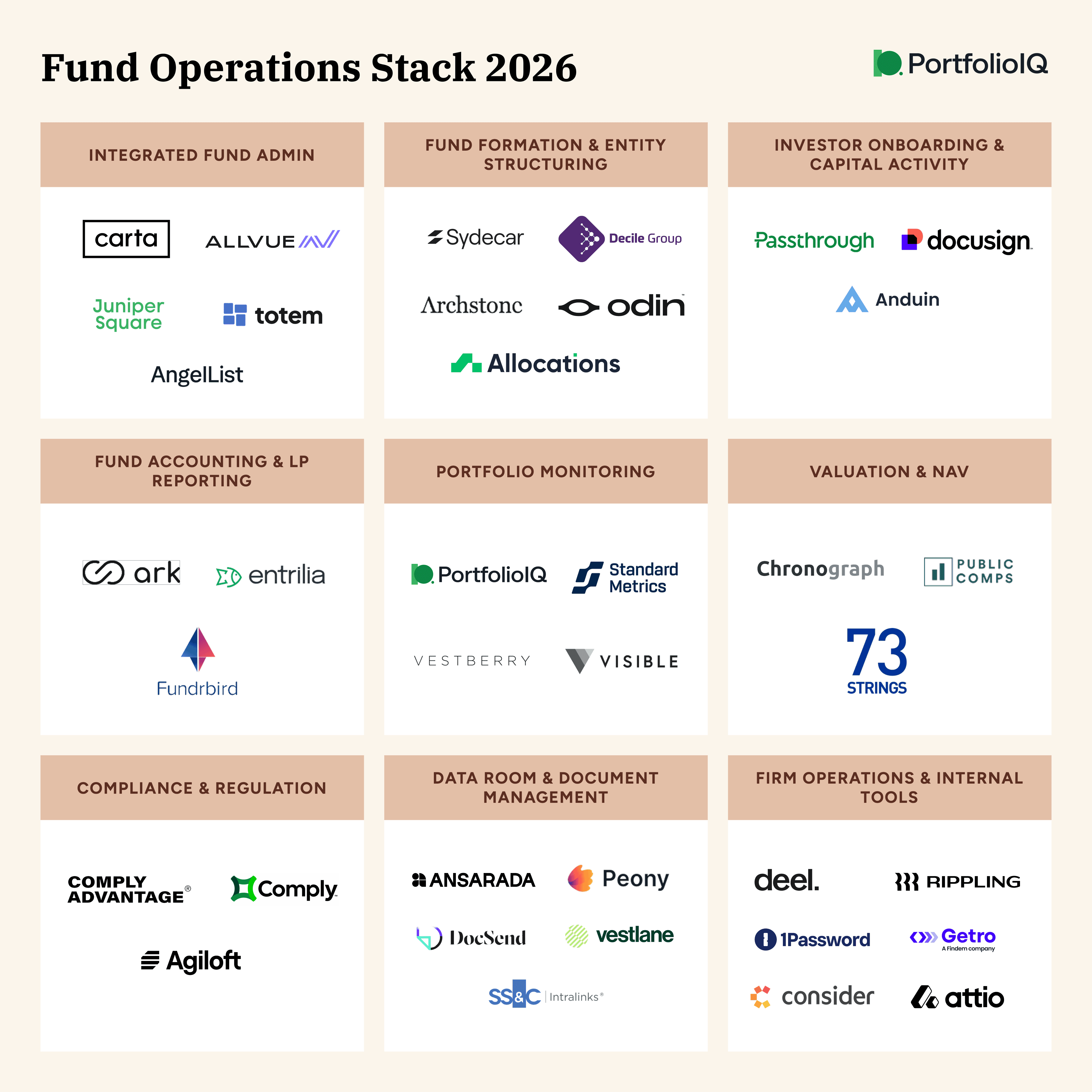
Looking for a broader set of tools for deal sourcing, market intelligence, diligence, or more? Check out 500+ tool recommendations in our 2026 VC Tech Stack list.
Best all-in-one fund administration tools for VC funds
A handful of platforms, such as Carta, Juniper Square, Allvue, and AngelList, don't fit into a single category. They span fund formation, capital calls, accounting, LP reporting, and (in some cases) portfolio monitoring and compliance from a single system of record.
For many funds, one platform serves as the foundation, with specialized tools added where needed.
An all-in-one platform gives you one login, one data model, and one vendor relationship, making it attractive for lean teams. Point solutions give you deeper functionality in each layer, at the cost of integration work and more contracts to manage. In general, as a fund grows in complexity with more vehicles, LPs, and regulatory surface area, the balance often shifts toward a strong core platform supported by specialized tools.
Platform | Spans | Core strength | Best for |
|---|---|---|---|
Carta | Formation, capital calls, fund accounting, cap tables, valuations, LP reporting | Integrated equity + fund admin | Emerging to mid-sized VCs ($10M–$200M+ AUM), especially teams already on Carta for portfolio cap tables |
Juniper Square | Formation, capital calls, fund accounting, LP portals, investor relations | Investor relations & LP experience | Mid-to-large and institutional funds ($100M+ AUM) prioritizing polished IR and enterprise compliance |
Allvue | Fund accounting, LP reporting, portfolio monitoring, compliance | Enterprise-grade accounting | Mid-to-large, growth equity, and institutional funds ($100M+ AUM) needing scalable multi-fund accounting |
AngelList | SPV/fund launch, banking, capital calls, investor onboarding, back office | Fast, low-overhead launch | Emerging managers, syndicate leads, and rolling-fund operators ($5M–$100M+ AUM) |
Carta
Carta is an equity management and fund administration platform that spans the full fund lifecycle: entity formation, legal document generation (LPA, subscription agreements), SPV creation, compliance setup (SEC filings, ERA registration), capital calls, fund accounting, cap-table management, valuations, and LP reporting.
All the features are integrated into one system, with automated KYC/AML and support for onshore, offshore, hybrid, and rolling-fund structures.
Primary use case: Running formation, capital activity, accounting, and LP reporting from a single integrated equity and fund-admin platform.
Best for: Emerging to mid-sized VCs ($10M–$200M+ AUM) and growth funds seeking integrated equity + fund admin, especially teams already using Carta for portfolio cap tables or needing Singapore/Asia-friendly offshore options.
Juniper Square
Juniper Square is an investor relations and fund administration platform covering fund setup, capital calls, fund accounting, and ongoing LP management, with automated investor portals, customizable fund structures, built-in compliance tools, audit trails, and capital-call workflows. Its LP-facing experience is the most polished of the group.
Primary use case: Institutional-grade fund administration and investor relations, from formation and capital calls through accounting and LP reporting.
Best for: Mid-to-large VCs and institutional funds ($100M+ AUM) prioritizing polished investor relations, enterprise-grade compliance, and scalable LP portals.
Allvue Systems
Allvue Systems is a comprehensive fund administration and accounting platform built for private capital (VC, PE, credit, real assets), delivering integrated fund accounting (general ledger, waterfalls, carried interest, NAV, accruals), automated LP reporting, portfolio monitoring, compliance and regulatory tools, and a self-service investor portal in a single Microsoft-based ecosystem.
Primary use case: End-to-end fund accounting, automated LP reporting, portfolio monitoring, and compliance management.
Best for: Mid-to-large VCs, growth equity, and institutional funds ($100M+ AUM) requiring enterprise-grade accounting, scalable multi-fund support, and unified reporting in a Microsoft-integrated environment.
AngelList
AngelList is an all-in-one platform for emerging VCs, covering SPV launch, rolling funds, venture funds, and syndicates, with automated legal documentation, built-in banking, compliance automation (KYC/AML, accreditation), investor onboarding portals, capital-call management, data rooms, and back-office support via its Belltower partnership.
Primary use case: Launch and run funds and deal-specific SPVs on a single integrated platform, automating compliance, investor management, and ongoing administration.
Best for: Emerging managers, syndicate leads, and smaller-to-mid VCs ($5M–$100M+ AUM) focused on rolling funds, deal-by-deal SPVs, first-time funds, or teams that want low-friction launch plus ecosystem advantages.
Best fund formation & entity structuring tools for VC funds
Also known as: Fund Formation, Legal Structuring, SPV Management, Entity Setup
Fund formation is where the operational stack begins: standing up the legal entity, generating fund documents (LPA, subscription agreements), handling regulatory filings (Form D, Blue Sky), and opening the fund's bank account.
These tools compress what used to be a weeks-long legal process into days, especially for SPVs and first funds, by templatizing documents and automating the compliance steps that follow.
Tool | Key features | Best for |
|---|---|---|
Sydecar | One-click SPV creation with automated legal docs, investor onboarding & e-signature, built-in banking & capital-call management, integrated cap-table tracking, compliance automation (K-1s, tax docs, Form D, Blue Sky) | Emerging managers, syndicate leads, and repeat SPV operators ($5M–$100M+ AUM) |
Allocations | Instant SPV/fund setup (minutes to hours), integrated investor portals, capital calls/distributions, tax coordination, end-to-end lifecycle from formation to exit | Emerging to mid-sized VCs, syndicate leads, and repeat SPV operators ($10M–$200M+ AUM) |
Archstone | Flat-rate platform (from ~$297/mo, no per-SPV fees): white-label LP portal, data room, deal pipeline, cap table, portfolio tracking, compliance, AI orchestration, ILPA-format reporting | Emerging managers running early funds (Fund I–III) avoiding per-SPV pricing |
Odin | Same-day SPV setup with USD/GBP/EUR bank accounts, automated legals, investor onboarding & payments, flexible carried-interest management, tax reporting | Angels, syndicate leads, and emerging managers (UK/Europe) building a track record |
Decile Group | AI-driven fund formation (Start Fund: entity + compliance docs in ~a day, zero legal fees), plus Decile Hub for ongoing admin, accounting, capital calls, LP reporting, and K-1s | First-time and emerging managers launching a fund end to end |
Sydecar
Sydecar is a deal-execution and fund-administration platform specializing in fast SPV and fund setup for venture investors. It automates entity formation (Delaware Series LLC), legal documents (investment agreements, LLCA), regulatory filings (Form D, Blue Sky), instant banking, KYC/AML compliance, investor onboarding, tax prep (K-1s), and distributions.
Primary use case: Rapid SPV/fund formation, legal structuring, compliance setup, and investor onboarding.
Best for: Emerging managers, syndicate leads, and repeat SPV operators ($5M–$100M+ AUM) prioritizing speed, transparent pricing, and low-friction setup for deal-by-deal or early fund vehicles.
Allocations
Allocations is a full-stack fund administration and setup platform for modern private funds (VC, PE, hybrids), enabling fast entity formation, SPV launch, legal templates, banking integration, investor onboarding, KYC/AML, compliance filings, and scalable admin.
Primary use case: Rapid, end-to-end fund formation, SPV structuring, compliance setup, and investor onboarding to operationalize vehicles scalably.
Best for: Emerging to mid-sized VCs, syndicate leads, and repeat SPV operators ($10M–$200M+ AUM) prioritizing speed, transparent pricing, full-lifecycle coverage, and scalability across multiple funds or vehicles.
Archstone
Archstone is a fund management platform for emerging VCs that bundles a white-label LP portal, data room, deal pipeline, cap table, portfolio tracking, compliance, and AI orchestration into a single flat-rate subscription rather than charging per SPV or per user.
Built for Fund I–III operations, it coordinates K-1s with your fund admin and delivers ILPA-format quarterly reports with SOC 2-ready security.
Primary use case: Running formation, LP reporting, and day-to-day fund operations on a predictable flat monthly fee instead of incremental per-vehicle costs.
Best for: Emerging managers running early funds (Fund I–III) who want to avoid per-SPV fees and present an institutional LP experience on a lean budget.
Odin
Odin is a platform for raising and deploying capital through SPVs and syndicates, used by founders, angel syndicates, and emerging fund managers worldwide. It handles entity formation, multi-currency banking (USD/GBP/EUR), legal docs, investor onboarding, payments, carried interest, and tax reporting in one place.
Primary use case: Launching and administering deal-by-deal SPVs and syndicates, especially for managers building a verified track record before raising a fund.
Best for: Angels, syndicate leads, and emerging managers—particularly in the UK and Europe—who want same-day SPVs, multi-currency banking, and flexible carry.
Decile Group
Decile Group helps emerging managers launch and run VC funds, pairing its Decile Hub software with fund administration and the VC Lab training program.
Its Start Fund product uses AI agents to handle entity formation, compliance documentation, and operational setup—compressing what once took three to six months into as little as a day, with zero legal fees. Meanwhile, Decile Hub then powers ongoing fund admin, accounting, capital calls, LP reporting, and K-1s for multiple funds and SPVs under one firm.
Primary use case: Launching a first or early institutional VC fund end-to-end formation, compliance docs, and operational infrastructure, then running it on the same platform.
Best for: First-time and emerging managers who want a guided, low-cost path from thesis to a deployed fund, with ongoing administration built in.
Best investor onboarding & capital activity tools for VC funds
Also known as: Subscriptions & Closings, KYC/AML, Capital Calls & Distributions
Collecting subscription documents, running KYC/AML checks, and issuing the first capital call are historically the most manual and error-prone stretch of fund Ops.
Investor onboarding and capital activity tools digitize the onboarding process and provide fund administrators with capital-call-ready data as soon as a close is completed.
Tool | Key features | Best for |
|---|---|---|
Passthrough | Guided e-subscription documents, embedded KYC/AML with daily sanctions/PEP screening, beneficial-ownership collection, capital-call-ready data export, CRM/portal/data-room integrations | Managers who want subscriptions and compliance handled in one workflow (any size; fully managed KYC/AML is US-only) |
Anduin | Adaptive e-subscription documents with up to 90% pre-fill, investor outreach, investment processing, capital-call & payment collection, in-platform LP/GP/counsel/admin commenting | GPs running frequent or large closings who want to cut onboarding friction |
DocuSign | Secure e-signature, reusable templates, workflow automation, audit trails, ESIGN Act & GDPR compliance | Funds that need reliable e-signature without a dedicated subscription platform |
Passthrough
Passthrough is a fund workflow automation platform that unifies electronic subscription documents and KYC/AML in a single system for investor onboarding, used by 300+ fund managers across 20 jurisdictions.
Its guided, TurboTax-style workflow walks LPs through sub docs with conditional logic (first investment in under 20 minutes, repeat investments in about 2), screens every profile against global sanctions, PEP, and criminal-activity lists with daily monitoring, collects beneficial-ownership documentation, and normalizes the captured data so administrators can issue capital calls faster.
Primary use case: Onboarding LPs end-to-end subscription documents, KYC/AML screening, and capital-call-ready data from one integrated platform.
Best for: Fund managers of any size that want subscriptions and financial-crime compliance handled in a single workflow rather than stitched across separate systems. Do note that the fully managed KYC/AML service is currently US-only.
Anduin
Anduin is an electronic subscription-document platform for private-market fundraising, built to speed up fund closings and improve the LP onboarding experience.
Its adaptive sub docs use conditional logic and pre-fill up to 90% of a returning investor's form, and its all-in-one workflow spans investor outreach, onboarding, investment processing, capital calls and payment collection, post-raise reporting, and direct in-platform commenting between LPs, GPs, law firms, and fund administrators.
The all-in-one workflow covers investor outreach, onboarding, investment processing, capital calls/payments, post-raise reporting, and in-platform collaboration (comments between LPs, GPs, law firms, and admins).
Primary use case: Digitizing subscription documents and closings to onboard LPs faster and cut the repetitive data entry and errors that delay closes.
Best for: GPs running frequent or large closings who want to reduce onboarding friction and keep LPs, counsel, and administrators coordinating in one place.
DocuSign
DocuSign is a cloud-based e-signature and agreement management platform with reusable templates, workflow automation, audit trails, and compliance features (ESIGN Act, GDPR).
In the fund ops context, it's the execution layer for signing fund documents—LPAs, subscription agreements, side letters, and capital-call notices—when a firm isn't routing those through a dedicated subscription platform.
Primary use case: Sending, tracking, and legally executing fund and LP documents by e-signature with minimal back-and-forth.
Best for: All VC sizes, especially emerging and mid-sized funds ($10M–$200M+ AUM) that need simple, reliable e-signatures and basic workflow automation without a full subscription-management platform.
Best fund accounting & LP reporting tools for VC funds
Also known as: Fund Administration, Financial Reporting, LP Reporting, Investor Portals
Fund accounting is the fund's ledger (capital accounts, waterfalls, carried interest, NAV, and accruals), and LP reporting is how those numbers reach investors as quarterly statements, capital-account summaries, and K-1s.
Modern VC fund administration software treats them as one workflow: the same ledger that closes the books feeds the LP portal. So the tools handle partnership accounting, capital accounts, waterfalls, fees, K-1s, performance metrics, and investor communications.
Tool | Key features | Best for |
|---|---|---|
ArkPES | Push-button investor reporting with Excel exports, purpose-built general ledger (ArkGL) with real-time financials and automated reconciliation, customizable dashboards, reporting & analytics | Emerging to mid-sized VCs, PE managers, and fund administrators ($50M–$500M+ AUM) |
Fundrbird | Automated, compliant quarterly investor reporting, integrated general ledger with automated capital accounts and waterfalls, API support for multi-fund structures, portfolio data aggregation with CRM and document management | Mid-sized to large European VCs and PE managers ($50M+ AUM) |
Entrilia | Real-time general ledger with private-fund accruals, waterfalls, and multi-currency support, automated capital calls & distributions, branded LP self-service portal, configurable quarterly & tax reporting, SOC 2 security & API | Emerging to mid-sized VCs and PE managers ($50M–$500M+ AUM) |
ArkPES
ArkPES is a cloud-based fund operations platform built for private capital (VC, PE, fund-of-funds, real estate), delivering integrated fund accounting, LP reporting, investor relations, and fundraising support in a configurable, intuitive system.
Its general ledger (ArkGL) is purpose-built for private funds, with real-time financials, automated workflows, and reconciliation, plus push-button investor reporting and Excel exports.
Primary use case: Integrated fund accounting, automated LP reporting, performance tracking, and compliance management delivering timely, transparent financials and investor statements with high configurability.
Best for: Emerging to mid-sized VCs, private equity managers, and fund administrators ($50M–$500M+ AUM) seeking a flexible, cloud-native alternative to legacy systems, with a strong focus on investor experience, automation, and cost-effective scalability.
Fundrbird
Fundrbird is a unified fund operations platform purpose-built for PE and VC managers, consolidating fund accounting, investor reporting, portfolio data collection, KYC/AML compliance, and investor onboarding into one consistent dataset. Its integrated general ledger automates capital accounts and waterfalls, and API support handles multi-fund structures.
Primary use case: Centralized fund accounting, automated investor reporting, compliance monitoring, and portfolio data management, delivering accurate financials and professional LP communications from a single reliable system.
Best for: Mid-sized to large European VCs and PE managers ($50M+ AUM) seeking a mature, integrated alternative to fragmented legacy tools, with strong emphasis on investor-reporting standards, compliance, and operational consistency (currently supports 550+ funds managing over €50B AUM).
Entrilia
Entrilia is a cloud-native, AI-assisted fund administration platform combining fund accounting, investor reporting, capital calls/distributions, compliance, and LP portals in one integrated system. Automated workflows, real-time data synchronization, and configurable templates handle general ledger, waterfalls, carried interest, NAV calculations, K-1 preparation, and multi-currency support, while delivering branded, interactive investor portals.
Primary use case: Automating fund-level financials, generating accurate LP statements, processing capital events, ensuring regulatory compliance, and providing transparent investor communications from a single, scalable platform.
Best for: Emerging to mid-sized VCs and private equity managers ($50M–$500M+ AUM) seeking a user-friendly, cost-effective alternative to legacy systems.
Best portfolio monitoring tools for VC funds
Also known as: Portfolio Tracking, Performance Management
Portfolio monitoring software collects KPIs from portfolio companies, standardizes them into comparable metrics with audit trails, benchmarks performance across the book, surfaces early warning signals, and feeds the numbers straight into quarterly LP reports.
Tool | Key features | Best for |
|---|---|---|
PortfolioIQ | Automated data collection, standardized metrics with audit trails, company intelligence hub (performance, ownership, notes), automated quarterly reports, benchmarking/analytics, qualitative insights from document themes | Mid-to-large VCs and multi-stage/multi-strategy funds ($100M+ AUM) |
Standard Metrics | Real-time dashboards, peer benchmarking, automated LP reporting (quarterly updates, IRR/DPI/TVPI), performance scoring, trend analysis, exportable insights | Mid-to-large VCs and institutional funds ($100M+ AUM) |
Vestberry | KPI collection from portfolio companies, standardized metrics with audit trails, peer benchmarking (industry/vintage), automated quarterly/fund-level reports (DPI, TVPI, IRR), valuation modeling | Mid-to-large VCs and growth equity funds ($100M+ AUM) |
Visible.vc | Investor updates and stakeholder communication, automated portfolio data collection, KPI dashboards, portfolio and fund reporting, secure data rooms, investor pipeline/fundraising workflows, AI-driven insights and integrations. | Mid-to-large VCs and multi-stage funds ($100M+ AUM) |
PortfolioIQ
PortfolioIQ is an AI-powered portfolio monitoring tool that unifies scattered data (KPIs, cap tables, valuation models, documents) into a single source of truth, with proprietary AI extraction and 100% human-verified accuracy.
It automates data collection, extracts and standardizes metrics with audit trails, generates qualitative insights, benchmarks across companies and inbound deals, and auto-populates quarterly company- and fund-level reports from templates. Use its Associate AI for queries/reports, qualitative insights, benchmarking, Excel integration, and MCP for tools like Claude.
Primary use case: AI-driven, real-time consolidation of KPIs, docs, and cap tables into audit-ready dashboards and reports, cutting quarterly close effort by 500+ hours for fast analysis, board prep, LP reporting, and decision-making with strong emphasis on data prep automation and human oversight.
Best for: Mid-to-large VCs and multi-stage/multi-strategy funds ($100M+ AUM) needing accurate, scalable handling of unstructured data and automated reporting across complex portfolios.
Standard Metrics
Standard Metrics is an AI-powered portfolio monitoring and reporting platform built specifically for venture capital (VC) and private equity (PE) firms. It centralizes performance and investment data, documents, and notes from portfolio companies via secure data connectors, templates, and automated collection.
Primary use case: Automating and streamlining portfolio data collection, analysis, and reporting for VC/PE investors and their portfolio companies.
Best for: Mid-to-large VCs and institutional funds ($100M+ AUM) focused on data-driven portfolio management, LP transparency, and consistent benchmarking in growth-stage investments.
Vestberry
Vestberry is a portfolio intelligence and fund management platform for VC and PE, combining real-time data aggregation, performance tracking, benchmarking, and automated LP reporting in one dashboard. It provides real-time tracking of portfolio KPIs, performance benchmarking, and automated reporting to enable proactive oversight, risk detection, and LP transparency.
Primary use case: Centralizing scattered VC portfolio data, automating LP reporting/audits, KPI collection from companies, and delivering real-time intelligence for risk spotting, forecasting, and data-driven decisions.
Best for: Mid-to-large VCs and growth equity funds ($100M+ AUM).
Visible.vc
Visible.vc is an investor relationship and portfolio monitoring platform built for founders and VC firms. It centralizes portfolio company metrics, documents, updates, and dashboards, and it supports automated data collection, reporting, and LP-facing communication.
Primary use case: Automating portfolio data collection, investor updates, and lightweight portfolio reporting for VC firms and their portfolio companies.
Best for: Mid-to-large VCs and multi-stage funds ($100M+ AUM) looking for a founder-friendly portfolio monitoring and investor-relations hub, especially teams prioritizing updates, dashboards, and communication over deep fund accounting.
Best valuation & NAV tools for VC funds
Also known as: Fair Value, Marks, Portfolio Valuations
Every quarter, funds have to mark their positions to fair value under ASC 820 and IPEV guidelines, roll those marks up into net asset value (NAV), and defend the numbers to auditors and LPs. Done in spreadsheets, this is slow, error-prone, and hard to audit.
Valuation and NAV software builds defensible marks from comparable-company data, precedent transactions, and option-pricing models, keeps a full audit trail of every assumption, and produces the workpapers auditors expect.
Tool | Key features | Best for |
|---|---|---|
73 Strings | Automated equity and credit valuations, ASC 820 fair-value models, AI data extraction from source documents, real-time NAV, audit-ready workpapers and assumption trails | Mid-to-large VCs, growth equity, and institutional funds ($100M+ AUM, especially credit or complex portfolios) |
Chronograph | Valuation tracking with real-time validations, audit trails on every mark, quarterly NAV roll-up, extensible analytics, data warehousing/APIs | Mid-to-large VCs, growth equity, and institutional funds |
Public Comps | Instant trading comps, transaction comps, and valuation multiples from thousands of public peers and precedents, real-time market data, growth-adjusted multiples | Growth-stage and late-stage VCs ($100M+ AUM) writing large checks |
73 Strings
73 Strings is an AI-powered platform for alternative asset managers focused on data extraction, portfolio monitoring, and valuations.
It includes 73 Extract (unstructured data to structured), 73 Monitor (real-time performance analytics, dashboards, scenario modeling), and 73 Value (fast, audit-ready equity/credit valuations). Delivers 99% accuracy, 10x faster valuations, and strong compliance (SOC 1/2).
Primary use case: AI-driven, real-time monitoring of portfolio performance, KPIs, and trends from structured and unstructured data—enabling proactive oversight, predictive analysis, and automated reporting for LP transparency.
Best for: Mid-to-large VCs, growth equity, and institutional funds ($100M+ AUM), especially those with global or complex portfolios.
Chronograph
Chronograph is a comprehensive portfolio monitoring, valuation, and analytics platform for private capital.
It tracks valuations with real-time validations and audit trails on every mark, so the numbers feeding quarterly NAV are consistent, sourced, and defensible. It rolls company-level marks up to the fund level and keeps the supporting analytics in one place for internal reviews and audit support.
Primary use case: Maintain a validated, audit-ready record of portfolio valuations and roll them into quarterly NAV and LP reporting without rebuilding models each period.
Best for: Mid-to-large VCs, growth equity, and institutional funds, especially those with complex or multi-strategy portfolios that need airtight valuation audit trails.
Public Comps
Public Comps is an AI-powered valuation platform that instantly generates trading comps, transaction comps, and valuation multiples for any private company by analyzing thousands of public peers, precedents, and real-time market data.
Primary use case: Rapid public comps generation and valuation benchmarking to support quarterly marks, pricing negotiations, and defensible fair-value inputs.
Best for: Growth-stage and late-stage VCs ($100M+ AUM) writing large checks where rigorous, real-time public comps are expected and speed to conviction matters.
Best compliance & regulatory tools for VC funds
Also known as: KYC/AML, RegTech, Regulatory Filings
Regulatory compliance tools help VC firms manage investor onboarding, anti-money laundering (AML), know-your-customer (KYC)/know-your-business (KYB), beneficial ownership checks, sanctions/PEP screening, ongoing monitoring, and regulatory filings (e.g., Form ADV, Form D, Form PF, AIFMD, FATCA/CRS).
Tool | Key features | Best for |
|---|---|---|
ComplyAdvantage | Real-time sanctions/watchlist, PEP, and adverse-media screening, AI-driven detection across 30,000+ data sources, false-positive reduction up to 70%, case management, configurable risk profiles, REST API | Funds and fund admins running KYC/AML on investors at scale |
COMPLY (ComplySci / RIA in a Box) | SEC/state RIA compliance, Form ADV and U4 filing support, compliance calendar, code-of-ethics and personal-trading monitoring, private-fund inventory, consultant-backed policies | SEC-registered advisers and exempt reporting advisers (ERAs) |
Agiloft | No-code contract lifecycle management, AI redlining and approvals, obligation and renewal tracking, 1,000+ integrations, audit trails | Mid-to-large funds managing high volumes of side letters and fund docs |
ComplyAdvantage
ComplyAdvantage is an AI-powered AML and KYC platform that screens investors and counterparties against sanctions lists, watchlists, PEP databases, and adverse media in real time. It compiles risk data from more than 30,000 sources, pushes sanctions changes into screening within hours, and layers on case management and configurable risk profiles to cut false positives by up to 70%.
Primary use case: Automate investor KYC/AML screening at onboarding and monitor for sanctions and adverse-media hits on an ongoing basis, with an audit trail for every decision.
Best for: Funds and fund administrators that need to screen investors at scale and document a defensible AML program.
COMPLY
COMPLY (formerly ComplySci and RIA in a Box) is a regulatory compliance platform for investment advisers, with a dedicated Private Fund Platform for VC, PE, and hedge fund managers. It combines software and consultant support to manage SEC and state obligations—Form ADV and U4 filings, a compliance calendar, code-of-ethics and personal-trading monitoring, and a private-fund inventory tied to Form ADV disclosures.
Primary use case: Manage RIA registration and ongoing regulatory obligations—filings, policies, and employee compliance—without building an in-house compliance function.
Best for: SEC-registered private fund advisers and exempt reporting advisers (ERAs) that need structured, consultant-backed regulatory compliance.
Agiloft
Agiloft is a no-code, AI-powered Contract Lifecycle Management (CLM) platform that serves as a centralized system for creating, negotiating, executing, and managing contracts. It features strong AI for risk detection, obligation tracking, clause analysis, and compliance automation (Agiloft Astra).
Primary use case: Automating high-risk contract processes such as LP subscription agreements, side letters, portfolio company investment docs, NDAs, and service agreements.
Best for: Mid-to-large VCs and growth-stage funds ($100M+ AUM) handling sophisticated, multi-party agreements and heavy side-letter volume.
Best data room & document management tools for VC funds
Also known as: Virtual Data Rooms, VDR, Document Sharing, Secure File Storage
Data room and document management tools give funds a controlled place to share and store a fund’s most sensitive documents: granular permissions, dynamic watermarks, NDA gating, expiring links, and page-level analytics that show exactly who read what.
In fund ops, they show up in two modes: purpose-built virtual data rooms for fundraising and diligence, and general document management systems for the firm's day-to-day files. The right choice depends on how sensitive the material is and how much you need to track engagement.
Tool | Key features | Best for |
|---|---|---|
Ansarada | AI-powered VDR, drag-and-drop uploads, granular permissions, audit trails, AI Smart Q&A, smart redaction, document translation | Mid-to-large VCs and growth-stage funds ($100M+ AUM) on complex or international deals |
Peony | AI-native data room, NDA gating, dynamic per-viewer watermarks, page-level engagement analytics, AI document Q&A, sub-5-minute setup | Emerging managers and startups running lean LP or diligence data rooms |
DocSend | Document sharing with granular link controls, real-time page-by-page analytics, dynamic watermarks, one-click access revocation, e-signature | GPs sharing decks, memos, and LP updates and tracking engagement |
Intralinks | Enterprise-grade VDR, bank-level security, AI redaction, Zero-Footprint viewer, deep permissioning and audit reporting | Large/institutional funds and complex capital raises |
Ansarada
Ansarada is an AI-powered virtual data room (VDR) and transaction management platform for secure document sharing, due diligence, and deal execution across M&A, capital raising, and investments. It combines controlled data rooms with streamlined Q&A, smart redaction, and workflow automation to move deals to close with speed and certainty.
Primary use case: Share final documents securely, manage negotiations and Q&A, track approvals, and ensure compliant execution during raises and diligence.
Best for: Mid-to-large VCs and growth-stage funds ($100M+ AUM) handling complex or international deals.
Peony
Peony is an AI-native virtual data room built for speed and engagement tracking, used by startups, funds, and advisors. It stands up a room in under five minutes with auto-indexing, then layers on NDA gating, dynamic per-viewer watermarks, expiring links, and page-level analytics that show which documents each LP read and for how long—plus AI document Q&A that answers diligence questions from the uploaded files.
Primary use case: Run lean LP or diligence data rooms with tight access controls and real-time visibility into investor engagement.
Best for: Emerging managers and startups that want a modern, low-overhead data room without enterprise pricing or setup.
DocSend
DocSend (a Dropbox company) is a document-sharing and tracking platform that turns any file into a secure, trackable link. It offers granular link controls, dynamic watermarks, one-click access revocation, e-signature, and page-by-page analytics showing exactly how recipients engage with a document.
Primary use case: Share pitch decks, fund updates, and LP materials as controlled links and see precisely who viewed which pages.
Best for: GPs and emerging managers who share documents frequently and want lightweight tracking without a full VDR.
Intralinks
Intralinks (an SS&C company) is an enterprise-grade virtual data room used for high-stakes M&A, capital raising, and fund reporting. It brings bank-level security, AI-assisted redaction, a Zero-Footprint viewer, and granular permissioning with detailed audit reporting to the most sensitive document exchanges.
Primary use case: Manage large, complex raises and institutional LP data rooms where security, permissioning, and auditability are non-negotiable.
Best for: Large and institutional funds ($500M+ AUM) and complex, multi-party capital raises.
Best firm operations & internal tools for VC funds
Also known as: Firm Operations, Back-Office Admin, People & IT
A venture firm is itself a small business that hires, runs payroll, manages a CRM, and secures its own data.
These tools help VC firms streamline internal workflows, HR/people management, IT/security, fund accounting & administration, knowledge sharing, and day-to-day operations, freeing teams from administrative burden so they can focus on investing and supporting portfolio companies.
Tool | Key features | Best for |
|---|---|---|
Deel | Employer of Record in 150+ countries, contractor management, global payroll, PEO, HRIS | Firms with remote or international team members needing compliant hiring |
Rippling | Unified global payroll, HR, IT, and benefits in one system, onboarding and device management | Firms wanting HR, payroll, and IT consolidated on one platform |
Getro | Curated VC/startup talent network (500K+ candidates), job postings, AI matching, ecosystem referrals | Firms hiring investment and operations talent quickly |
Consider | Talent intelligence aggregating LinkedIn/GitHub and other data, AI matching, collaborative hiring | Firms sourcing internal and portfolio hires from ecosystem networks |
Attio | Flexible relational CRM, auto-sync of email/calendar/LinkedIn, real-time relationship profiles | Firms managing LP and ecosystem relationships with minimal upkeep |
1Password | Encrypted team vaults, shared access controls, Watchtower alerts, zero-knowledge architecture | Firms of any size securing credentials and sensitive documents |
Deel
Deel is a global payroll and HR platform that lets firms hire, pay, and manage talent compliantly in 150+ countries without setting up local entities, via Employer of Record (EOR), contractor management, global payroll, PEO services, and HRIS tools.
Primary use case: Hire and pay a distributed team—and support international portfolio companies—without entity setup or compliance risk.
Best for: Emerging to mid-sized VCs ($50M–$500M AUM) and growth-stage funds with remote or international team members.
Rippling
Rippling is a unified workforce management platform combining global payroll, HR, IT, and benefits in one system, so firms can hire, pay, onboard, and manage employees and contractors—and their devices—compliantly across countries.
Primary use case: Run payroll, HR, and IT for the firm on a single platform, cutting the admin overhead of stitching separate systems together.
Best for: Emerging to mid-sized VC firms ($50M–$500M AUM) that want HR, payroll, and IT consolidated in one place.
Getro
Getro is a talent network and hiring platform built for VC and startup teams, connecting firms with vetted talent—investors, operators, analysts, and portfolio support through curated networks, job postings, and AI matching.
Primary use case: Source and hire investment and operations talent for the firm, and make talent introductions to portfolio companies.
Best for: Emerging to mid-sized VC firms ($50M–$500M AUM) building out their internal teams.
Consider
Consider is a talent intelligence platform that aggregates networks and data (LinkedIn, GitHub, and more) to source, match, and introduce high-quality talent for both firm roles and portfolio companies, with AI recommendations and collaborative hiring workflows.
Primary use case: Fill firm and portfolio roles by tapping ecosystem connections and AI-driven candidate matching.
Best for: Emerging to mid-sized VC firms ($50M–$500M+ AUM) that hire heavily through their network.
Attio
Attio is a modern, flexible CRM built for high-velocity teams like VC firms, replacing rigid traditional CRMs with a relational database that auto-syncs emails, calendars, and LinkedIn into rich, real-time relationship profiles.
Primary use case: Centralize LP relationship management and fundraising outreach, logging interactions and segmenting contacts without manual data entry.
Best for: Emerging to mid-sized VC firms ($50M–$500M AUM) that want a low-maintenance CRM for LP and ecosystem relationships.
1Password
1Password is a secure password manager and digital vault for teams, providing end-to-end encrypted storage of passwords, API keys, SSH keys, and sensitive documents with a zero-knowledge architecture and shared-vault access controls.
Primary use case: Manage credentials and secrets across the firm with team sharing, access governance, and compliance-ready security.
Best for: Emerging to mid-sized VC firms ($50M–$500M AUM) needing simple, secure credential management for internal ops.
How to build your fund ops stack by fund size
How you build your fund ops stack should depend on your AUM, your LP count, and how much complexity you want to run in-house.
As a rough progression: emerging managers (sub-$50M, Fund I–II) bundle and outsource for speed and cost, growth-stage funds ($100M+, multiple funds) unbundle into specialists as complexity outpaces the all-in-one solutions, and institutional funds ($500M+, multi-strategy) typically run best-of-breed software across every category to support a large team.
Here's how this plays out across three tiers.
Bundle first, unbundle at the pain point. Emerging managers need speed and low cost, not depth. A single all-in-one platform can cover the essentials—formation, cap table, banking, and basic LP reporting—for little overhead, and an outsourced fund administrator handles the rest. Move a function onto a dedicated tool when running a function becomes painful: when the bundled feature can't handle your reporting or when a manual workaround eats real hours.
Buy specialized software only when the tool beats the workaround. Weigh software cost against the cost of doing the job manually (hours, error risk, and what breaks if the spreadsheet's owner leaves). Below ~$50M, a fund administrator and counsel can cover most middle-office work. But as AUM and audit scrutiny rise, the manual cost climbs faster than the software cost and dedicated tools start paying for themselves.
Optimize for data flow, not features. Choose the tool whose data connects cleanly to the rest of your back office stack. Before introducing a new tool, ask where its data comes from and where it needs to go. A slightly weaker tool that integrates beats a point solution that traps your data.
Frequently asked questions
What is a fund operations tech stack?
A fund operations tech stack is the software a VC firm uses to run its back and middle office after an investment is made. It covers fund formation, investor onboarding, capital calls, fund accounting, LP reporting, portfolio monitoring, valuations, compliance, and document management.
It's distinct from the front-office stack (sourcing, diligence, and deal execution), which we cover in our VC Tech Stack 2026 guide.
What software do VC funds use for fund administration?
VC funds use a mix of specialized fund administration platforms: fund accounting and LP reporting (ArkPES, Fundrbird, Entrilia), investor onboarding and capital calls (Passthrough, Anduin), portfolio monitoring (PortfolioIQ, Standard Metrics), and valuations (73 Strings, Chronograph). All-in-one platforms like Carta, Juniper Square, Allvue, or AngelList bundle several of these functions into one system, which can suit earlier-stage funds. But as AUM, LP count, and reporting complexity grow, most funds move toward specialist tools built for each job.
3. What's the difference between fund accounting and portfolio monitoring?
Fund accounting tracks the fund's finances—capital accounts, NAV, carried interest, and LP reporting. Portfolio monitoring tracks the performance of portfolio companies—revenue, growth, burn, and other KPIs. One measures fund performance; the other measures company performance.
Do emerging managers need fund admin software?
Not necessarily as a standalone purchase. Most emerging managers get what they need from an all-in-one platform (AngelList or Carta) plus a formation tool (Sydecar, Allocations, Odin, or Archstone), often paired with an outsourced fund administrator. Dedicated fund accounting, valuation, and enterprise compliance software usually becomes worthwhile around $50M–$100M AUM or when institutional LPs raise the reporting bar.
What's the difference between fund administration software and a fund administrator?
A fund administrator is an outsourced team that handles fund accounting, NAV calculations, capital calls, distributions, and LP reporting on your behalf. Fund administration software is the tooling that does those jobs, whether your in-house team runs it or your administrator does.
Most funds use both: an administrator for execution and software for visibility, control, and data management. As funds scale, the question is less "software or administrator?" and more "which functions do we run in-house versus hand off?"
Build the back office LPs trust
Monitoring and reporting are still the most manual parts of most funds, between chasing KPIs from portfolio companies and rebuilding the same reports every quarter.
That flow is exactly where PortfolioIQ fits. It saves funds 500+ hours a year by turning scattered data (KPIs, cap tables, valuations, documents) into one verified source of truth with AI extraction and human accuracy, then auto-populating clean company and fund-level reports. So if yours are still living in spreadsheets, start here. See how PortfolioIQ works →