MEETING PREP

Board Meeting Prep

Reading the deck alone misses what's between the lines. Here's how to use AI to reconcile pre-read claims to data, track multi-board commitments, and produce a 1-page meeting brief.
AI prompts for board meeting prep
  1. Build a pre-board scorecard

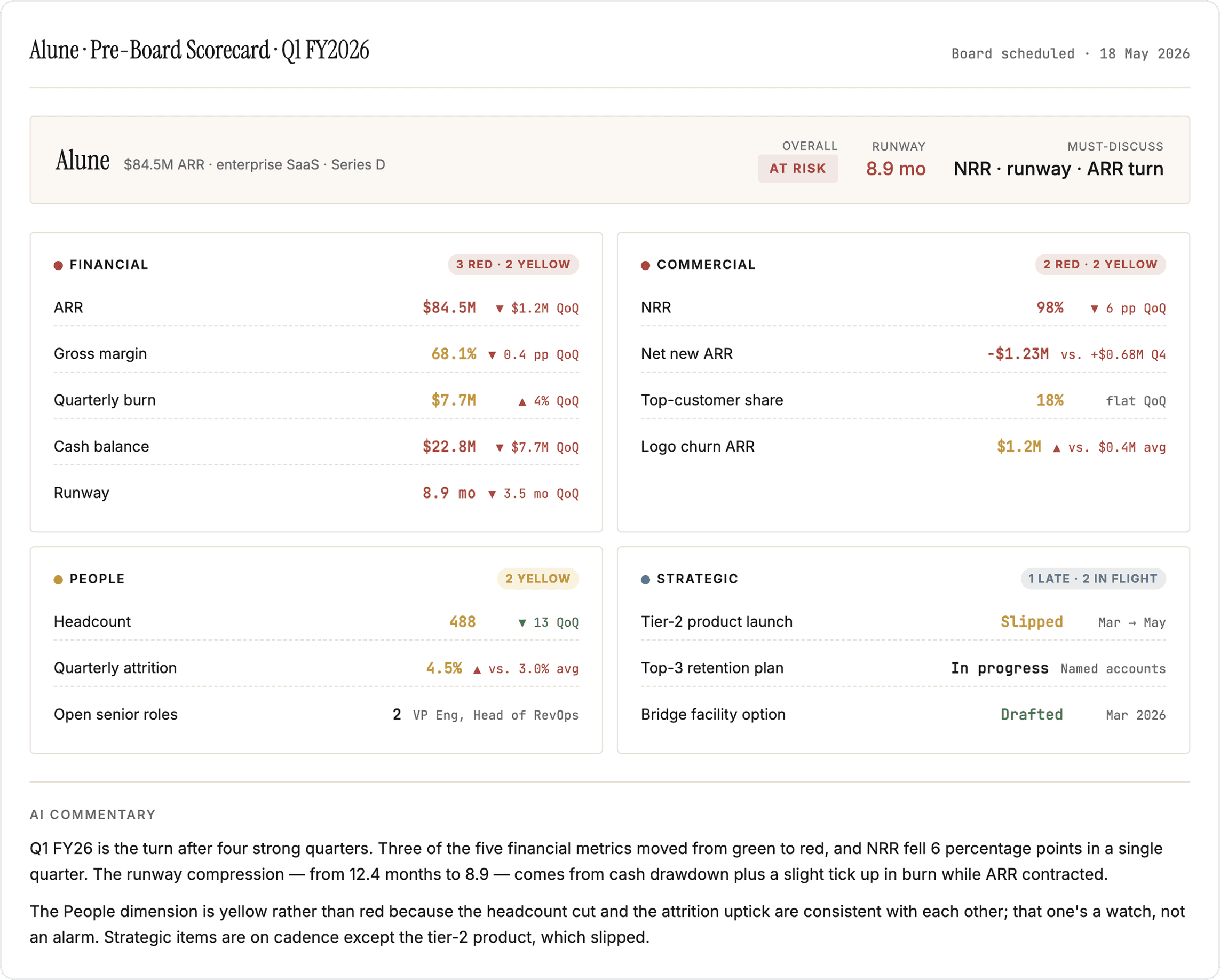
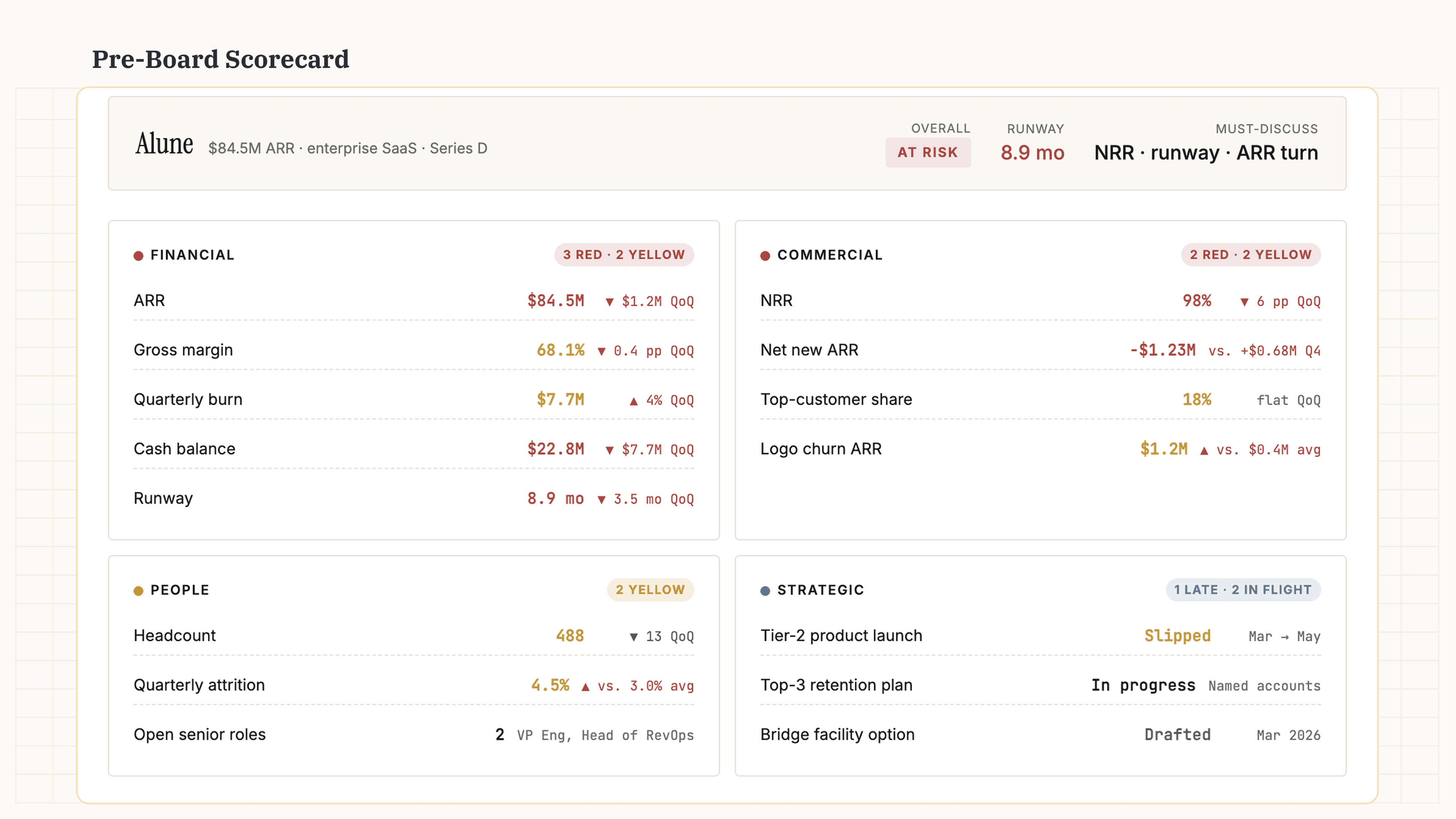
A scorecard pulled from the underlying data and colored against the company's plan gives you a structured read of where the company stands before the meeting.

Prepare your data
  • ARR, headcount, cash burn, runway, gross margin, and NRR for the latest two quarters

  • The company's operating plan or board-approved targets for those metrics

Prompt

Build a pre-board scorecard for [company], organized by dimension: - Financial: ARR, gross margin, quarterly burn, cash, runway - Commercial: NRR, net new ARR, top-customer concentration, logo churn - People: headcount, attrition, key role gaps - Strategic: status of in-flight initiatives committed at prior boards For each metric, show: current value, change vs. last quarter, and a status indicator (green / yellow / red) set against the company's own plan or board-approved threshold — not against absolute industry benchmarks. Add a headline strip with overall company status and the 2–3 must-discuss items.

Build a pre-board scorecard for [company], organized by dimension: - Financial: ARR, gross margin, quarterly burn, cash, runway - Commercial: NRR, net new ARR, top-customer concentration, logo churn - People: headcount, attrition, key role gaps - Strategic: status of in-flight initiatives committed at prior boards For each metric, show: current value, change vs. last quarter, and a status indicator (green / yellow / red) set against the company's own plan or board-approved threshold — not against absolute industry benchmarks. Add a headline strip with overall company status and the 2–3 must-discuss items.

Copy prompt

Copied

Output
Pre-board startup scorecard with financial risk metrics
  1. Reconcile the pre-read against the data

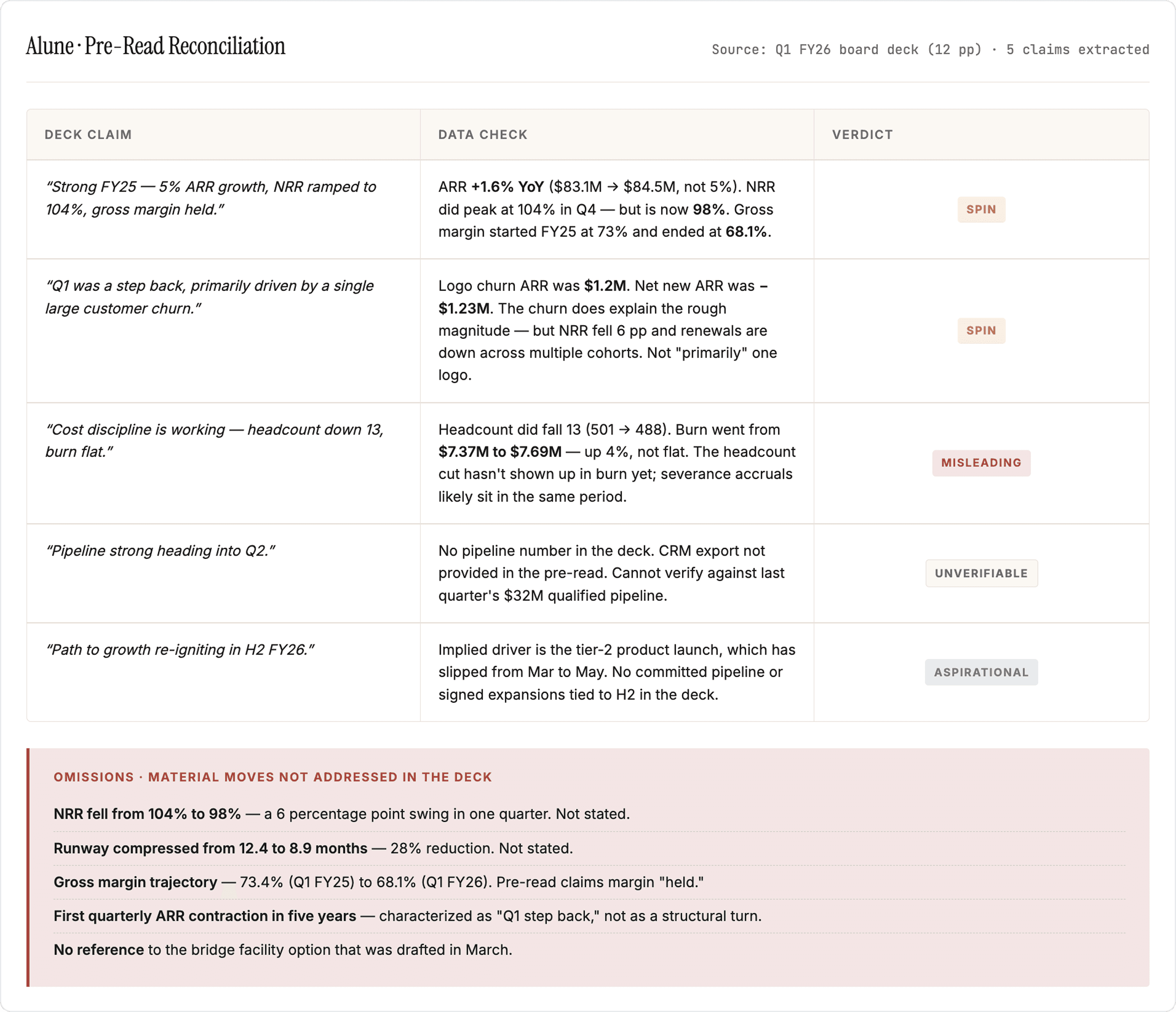
Pull every claim from the deck and match it to the underlying data to flag "spin", misleading framing, and omissions you might miss on a single read.

Prepare your data
  • The board's pre-read deck

  • Latest period KPIs from Step 1

Prompt

From the attached pre-read deck, extract every metric claim and every framing statement that implies a trajectory. For each, check the underlying data and classify the alignment: - Consistent — claim matches the data - Spin — claim is technically true but selective (e.g., quotes a peak that has since reversed) - Misleading — claim contradicts the data - Aspirational — claim is forward-looking with no anchor in the data - Unverifiable — no underlying data available Render as a three-column table: deck claim (verbatim quote), data check, classification badge. Below the table, list "Omissions" — material metrics that moved this quarter and DO NOT appear in the deck.

From the attached pre-read deck, extract every metric claim and every framing statement that implies a trajectory. For each, check the underlying data and classify the alignment: - Consistent — claim matches the data - Spin — claim is technically true but selective (e.g., quotes a peak that has since reversed) - Misleading — claim contradicts the data - Aspirational — claim is forward-looking with no anchor in the data - Unverifiable — no underlying data available Render as a three-column table: deck claim (verbatim quote), data check, classification badge. Below the table, list "Omissions" — material metrics that moved this quarter and DO NOT appear in the deck.

Copy prompt

Copied

Output
Board pre-read claims reconciliation and fact-check summary
  1. Surface the pattern across recent boards

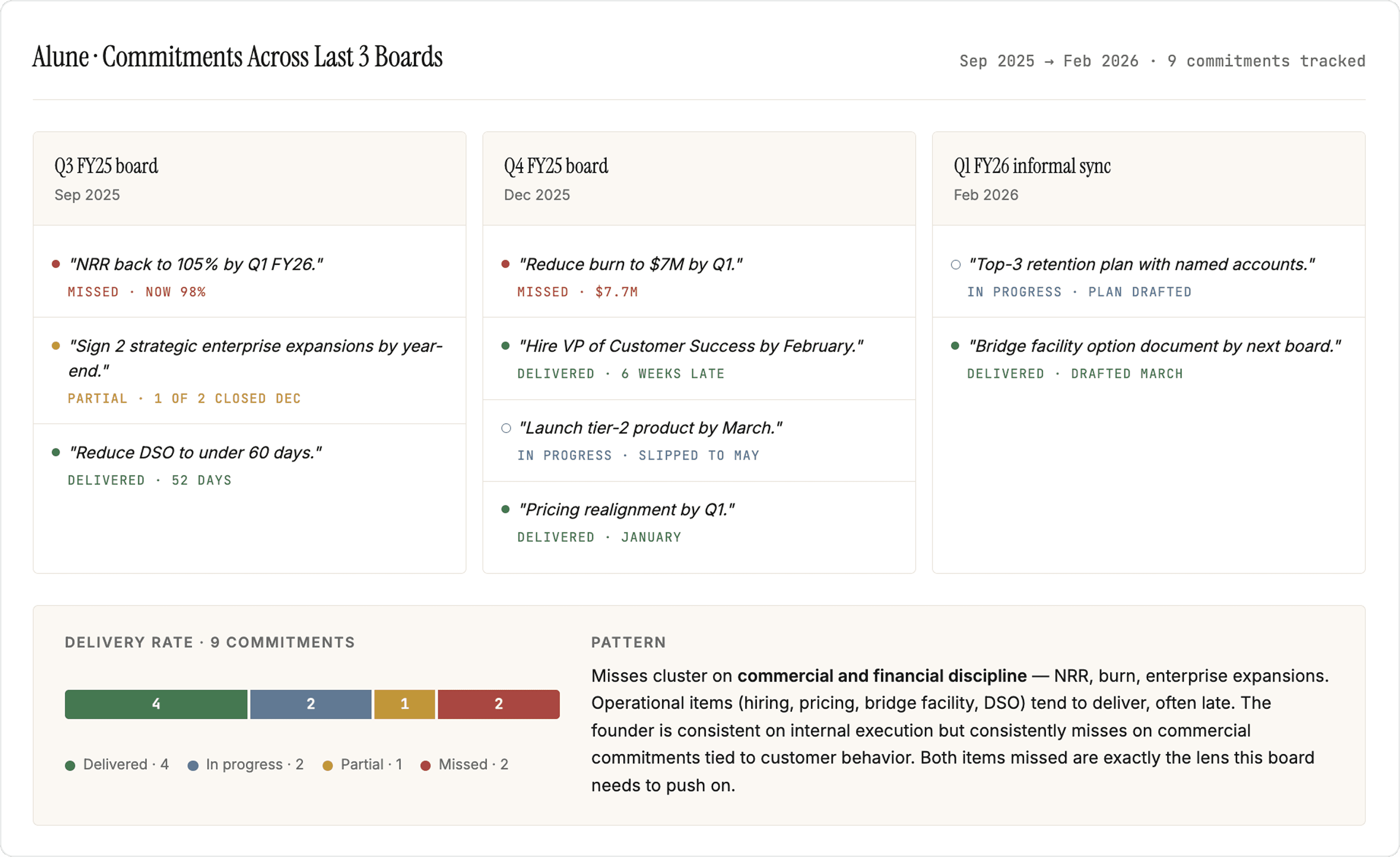
Commitments from prior boards are often scattered across notes, decks, and transcripts. Extract them, tag their status, and show what's been delivered vs. what's been dropped.

Prepare your data

The decks, minutes, and follow-up notes from the last three board meetings.

Prompt

From the prior three board meetings (decks, minutes, post-meeting notes), extract every commitment the founder made. For each: original commitment text (quote where possible), the board it was made at, due date if specified, and current status — delivered, in progress, missed, or dropped. Render as three columns by board (oldest to newest), with each commitment as a status-tagged row. Below, summarize the delivery rate and surface any pattern — are misses clustered around any one area, is the founder consistently late on a category, etc.

From the prior three board meetings (decks, minutes, post-meeting notes), extract every commitment the founder made. For each: original commitment text (quote where possible), the board it was made at, due date if specified, and current status — delivered, in progress, missed, or dropped. Render as three columns by board (oldest to newest), with each commitment as a status-tagged row. Below, summarize the delivery rate and surface any pattern — are misses clustered around any one area, is the founder consistently late on a category, etc.

Copy prompt

Copied

Output
Board commitments tracker across previous quarterly meetings
  1. Synthesize the 1-Page meeting brief

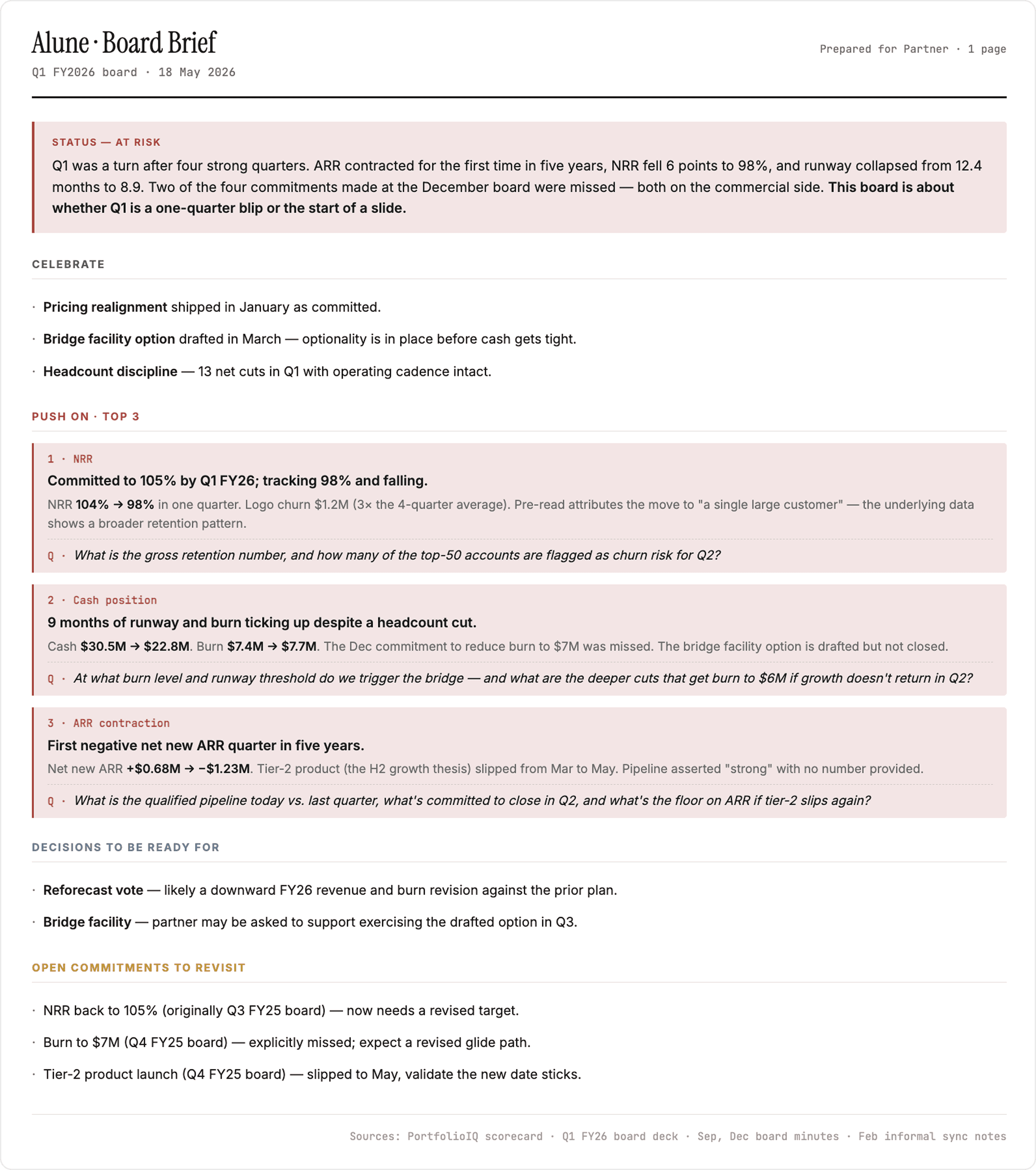
Synthesize the previous three steps into a 1-page brief: what to celebrate, what to push on, and what questions to ask.

Prepare your data

Outputs of Steps 1–3

Prompt

Produce a 1-page meeting brief for [company]'s upcoming board. Sections: - Status summary — 2 sentences on the headline state of the company - Celebrate — 2 to 3 things going genuinely well, with specifics - Push on — top 3 issues ranked by importance. For each: framing, the underlying number, the question to ask - Decisions to be ready for — anything the partner will be asked to vote or weigh in on - Open commitments to revisit — items from prior boards that need follow-up Every item must be grounded in either the scorecard, the deck reconciliation, or the commitments tracker. No general advice.

Produce a 1-page meeting brief for [company]'s upcoming board. Sections: - Status summary — 2 sentences on the headline state of the company - Celebrate — 2 to 3 things going genuinely well, with specifics - Push on — top 3 issues ranked by importance. For each: framing, the underlying number, the question to ask - Decisions to be ready for — anything the partner will be asked to vote or weigh in on - Open commitments to revisit — items from prior boards that need follow-up Every item must be grounded in either the scorecard, the deck reconciliation, or the commitments tracker. No general advice.

Copy prompt

Copied

Output
Executive board brief highlighting company risk areas

This analysis was one-shotted with Claude + PortfolioIQ MCP

This analysis was one-shotted with Claude + PortfolioIQ MCP

AI does great analysis, getting the data ready is the hard part

AI does great analysis, getting the data ready is the hard part

AI does great analysis, getting the data ready is the hard part

PortfolioIQ manages your data: extraction from documents, standardization, reconciliation across sources and human checks. Plugs latest, accruate data to wherever you do your work. Claude, ChatGPT, Excel or the PortfolioIQ platform.