COMPANY PERFORMANCE ANALYSIS

Portfolio Headcount Analysis

ARR per FTE looks identical whether the team got better or just smaller. Here's how to use AI to read hiring velocity, function mix, and the gap between numbers and narrative.
AI prompt to do portfolio headcount analysis
  1. Build a portfolio headcount dashboard

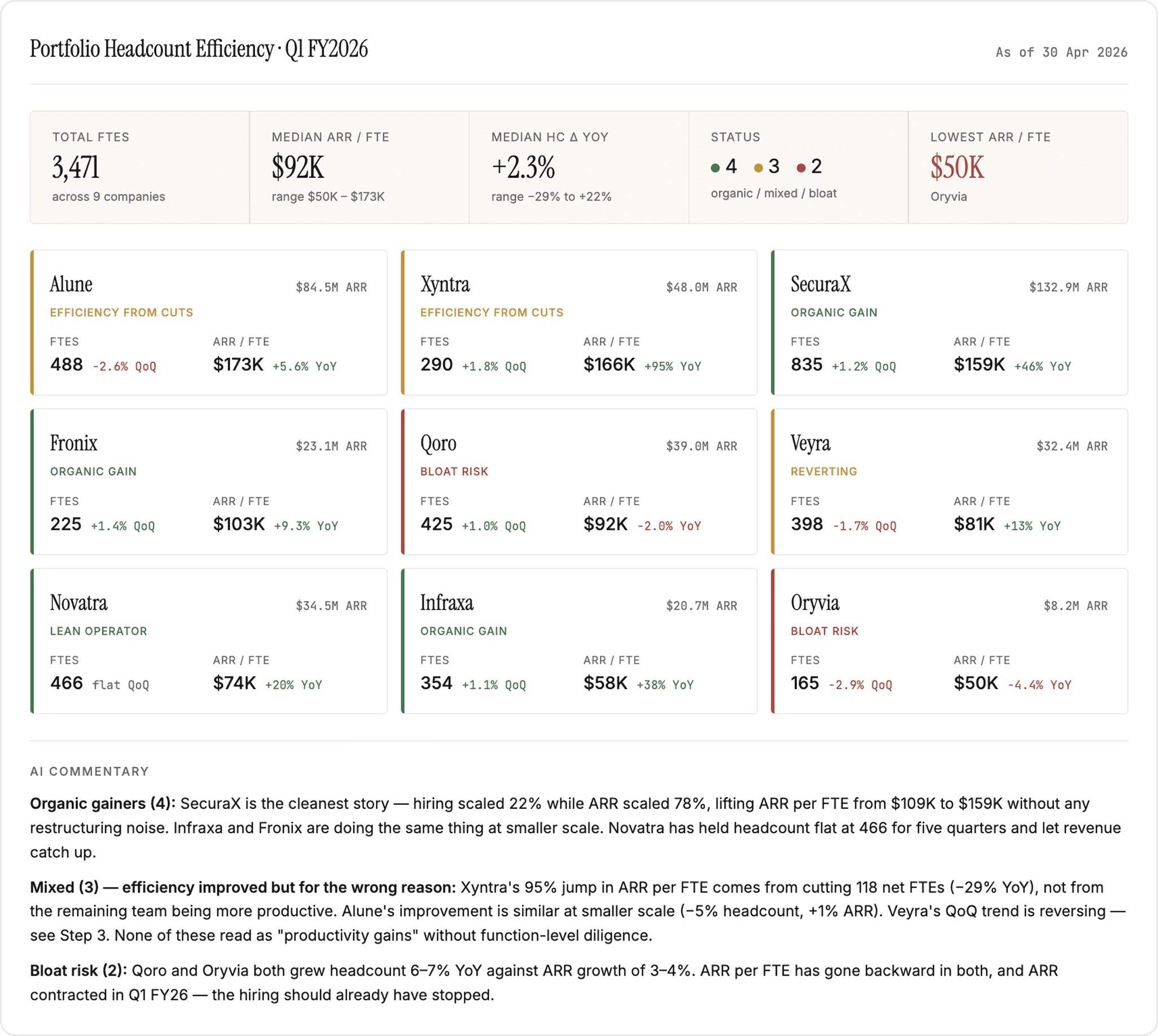
Sort companies by ARR per FTE, then put headcount and hiring velocity on the same screen to separate real productivity gains from headcount cuts.

Prepare your data

Quarterly ARR and headcount per company for the latest two quarters and the year-ago period.

Prompt

Build a portfolio headcount efficiency dashboard. One tile per company, sorted by ARR per FTE descending. Each tile shows: - Company name and current ARR - A short status tag describing the dominant pattern (e.g. "Organic gain", "Efficiency from cuts", "Bloat risk", "Stalled") - Headcount, with quarter-over-quarter delta - ARR per FTE, with year-over-year delta Color the tile by status: - Green if ARR per FTE is improving and the gain is organic — i.e. headcount is flat or growing slower than ARR - Yellow if ARR per FTE is improving but headcount is contracting (efficiency-from-cuts) or improving only marginally - Red if ARR per FTE is flat or declining despite hiring Add a KPI strip with portfolio totals: total FTEs, median ARR per FTE, median YoY headcount change, and a count of companies in each color tier. Below the grid, add an AI commentary section that explains the pattern in each color tier in 2–4 sentences. Important: separate "organic productivity gain" (revenue grew faster than the team) from "denominator shrink" (the team got smaller faster than revenue grew). Both look identical on a sort.

Build a portfolio headcount efficiency dashboard. One tile per company, sorted by ARR per FTE descending. Each tile shows: - Company name and current ARR - A short status tag describing the dominant pattern (e.g. "Organic gain", "Efficiency from cuts", "Bloat risk", "Stalled") - Headcount, with quarter-over-quarter delta - ARR per FTE, with year-over-year delta Color the tile by status: - Green if ARR per FTE is improving and the gain is organic — i.e. headcount is flat or growing slower than ARR - Yellow if ARR per FTE is improving but headcount is contracting (efficiency-from-cuts) or improving only marginally - Red if ARR per FTE is flat or declining despite hiring Add a KPI strip with portfolio totals: total FTEs, median ARR per FTE, median YoY headcount change, and a count of companies in each color tier. Below the grid, add an AI commentary section that explains the pattern in each color tier in 2–4 sentences. Important: separate "organic productivity gain" (revenue grew faster than the team) from "denominator shrink" (the team got smaller faster than revenue grew). Both look identical on a sort.

Copy prompt

Copied

Output
Tracking portfolio headcount efficiency
  1. Sharpen the view by comparing hiring to growth

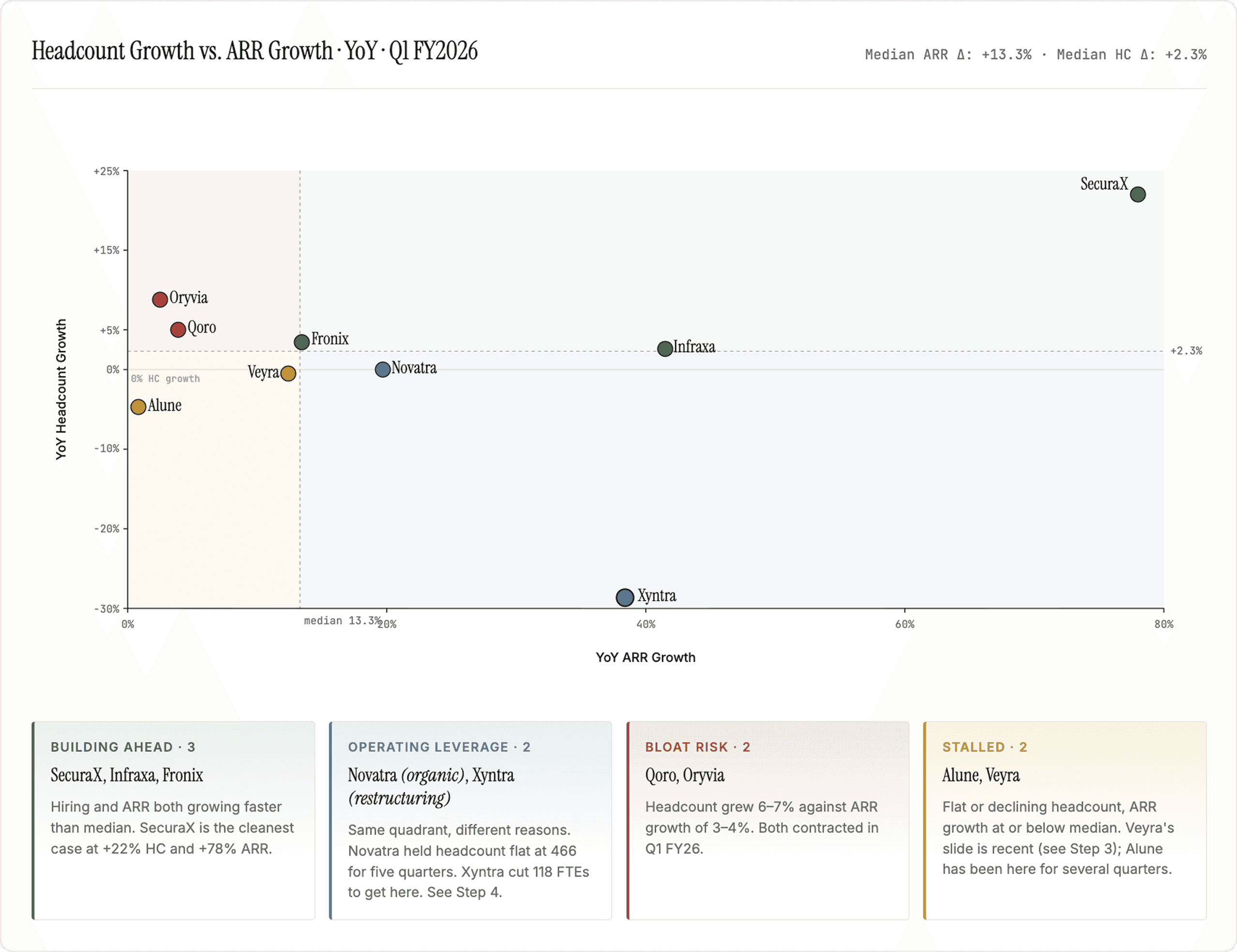
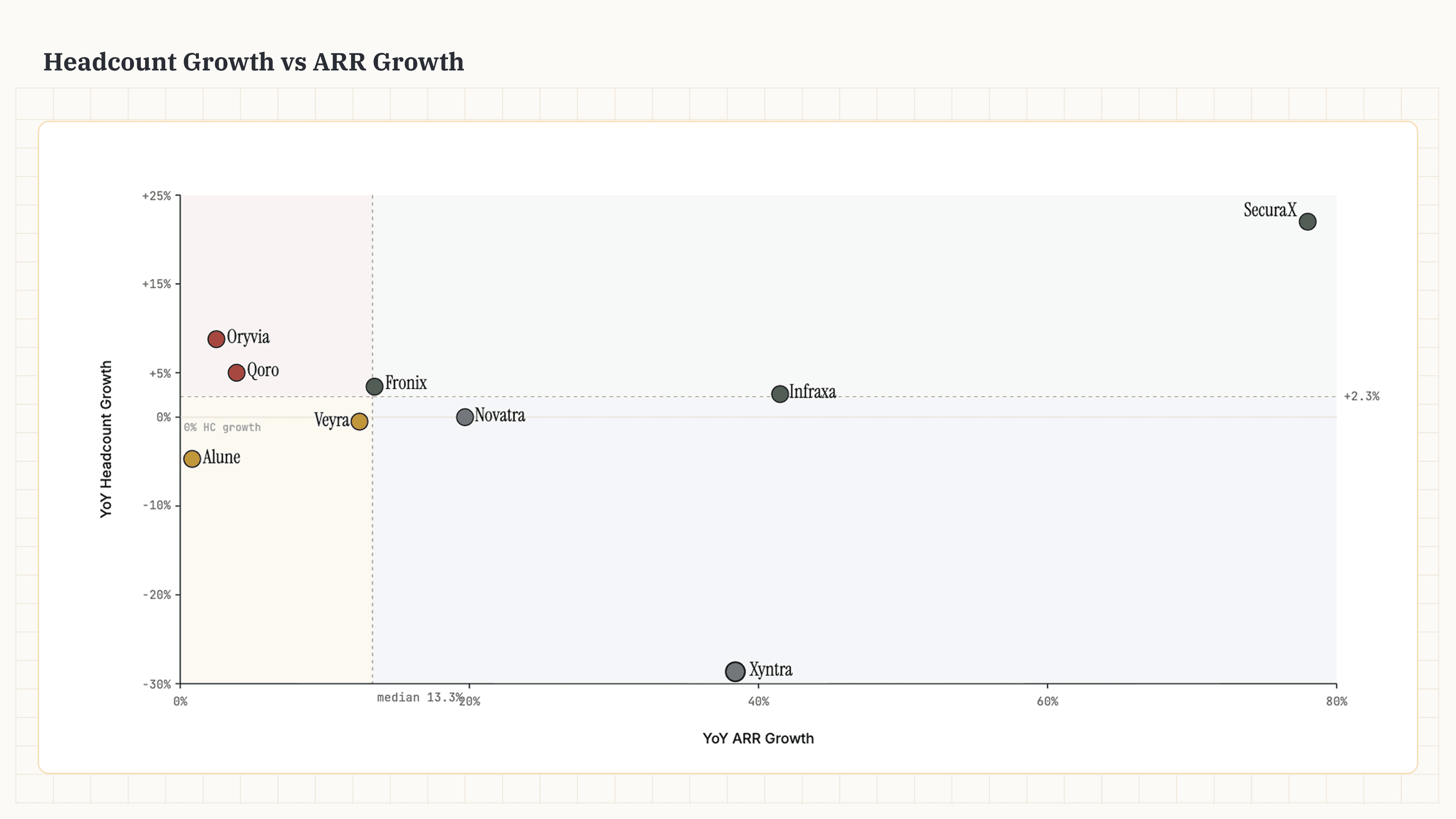
Plotting headcount growth against ARR growth shows the trajectory of the company and identifies companies that are able to convert productivity to growth.

Prepare your data
  • Year-over-year ARR growth and headcount growth per company

  • Recent quarterly board updates to provide context behind each company's position

Prompt

Build a 2x2 plotting YoY ARR growth on the X axis and YoY headcount growth on the Y axis, with reference lines at portfolio median for each axis. Plot one point per company with the company name beside it. Do not put quadrant labels or annotations inside the chart — keep the plot clean. Below the chart, render four readout cells — one per quadrant — that act as the legend: - Top-right (HC and ARR both above median) — "Building Ahead" - Bottom-right (HC below median, ARR above) — "Operating Leverage" - Top-left (HC above median, ARR below) — "Bloat Risk" - Bottom-left (HC and ARR both below median) — "Stalled" Each readout shows the quadrant name, the companies in it, and one or two sentences interpreting the position. In the "Operating Leverage" readout, classify each company as organic (revenue grew faster than the existing team) or restructuring-driven (denominator shrank). The 2x2 cannot tell these apart on its own — the reader needs to know which is which.

Build a 2x2 plotting YoY ARR growth on the X axis and YoY headcount growth on the Y axis, with reference lines at portfolio median for each axis. Plot one point per company with the company name beside it. Do not put quadrant labels or annotations inside the chart — keep the plot clean. Below the chart, render four readout cells — one per quadrant — that act as the legend: - Top-right (HC and ARR both above median) — "Building Ahead" - Bottom-right (HC below median, ARR above) — "Operating Leverage" - Top-left (HC above median, ARR below) — "Bloat Risk" - Bottom-left (HC and ARR both below median) — "Stalled" Each readout shows the quadrant name, the companies in it, and one or two sentences interpreting the position. In the "Operating Leverage" readout, classify each company as organic (revenue grew faster than the existing team) or restructuring-driven (denominator shrank). The 2x2 cannot tell these apart on its own — the reader needs to know which is which.

Copy prompt

Copied

Output
Headcount Growth vs ARR Growth Matrix
  1. Switch from point-in-time to trends

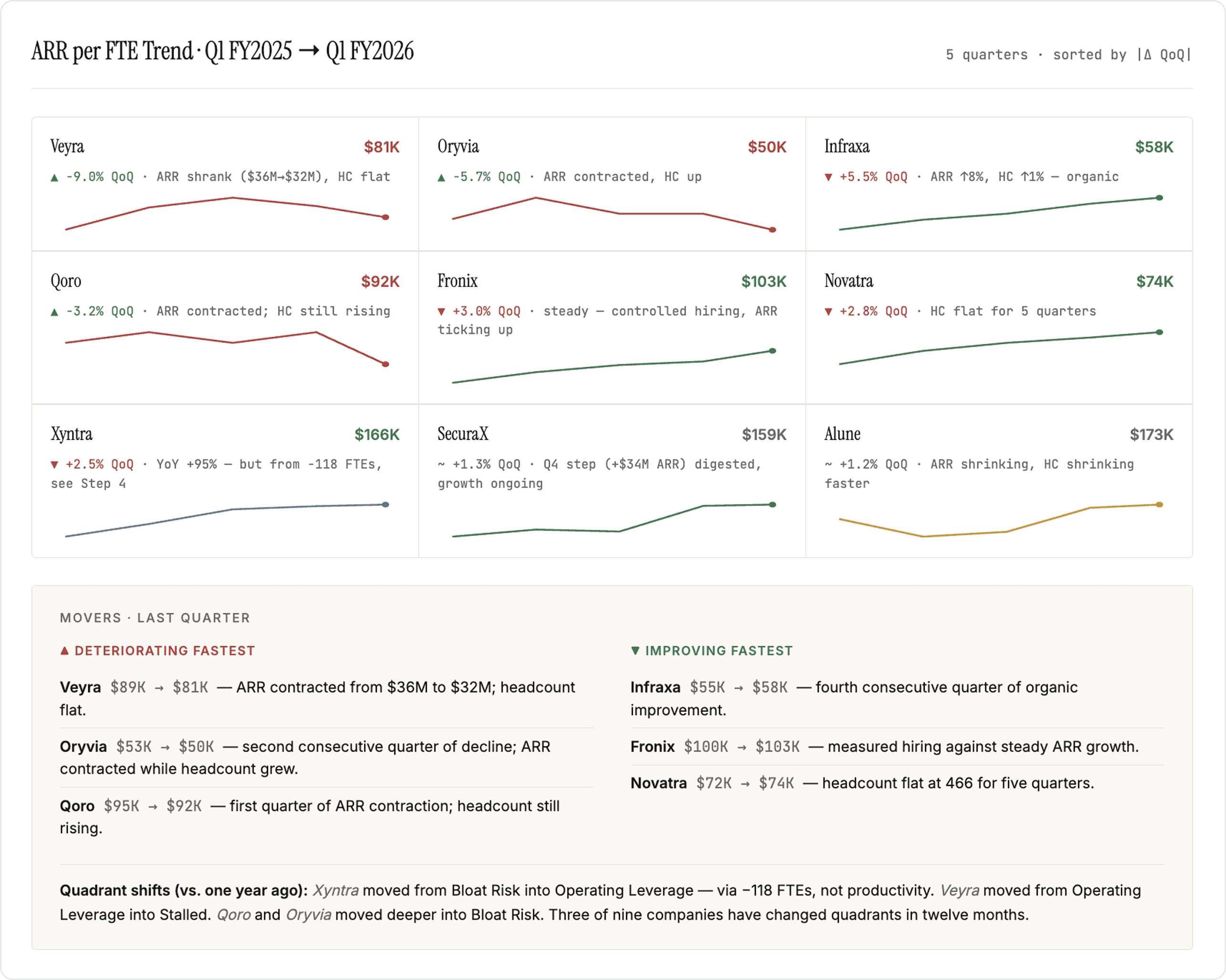
A snapshot can overstate efficiency for companies that are restructuring and understates it for companies are hiring aggressively. Five quarters of ARR per FTE show whether the gain is sustained or a one-time step.

Prepare your data
  • Five quarters of ARR and headcount per company

  • CEO updates and any restructuring memos from the period to attribute each move to its driver

Prompt

For each portfolio company, plot a five-quarter sparkline of ARR per FTE with the latest value labeled. Below each sparkline, in one line, attribute the latest quarterly change to its underlying driver: - Was it driven by ARR change, headcount change, or both? - Was the headcount move organic (hiring, attrition) or one-time (layoff, acquisition)? Sort cells by absolute QoQ change in ARR per FTE — biggest movers first. Color the latest-value text by direction: red if declining, green if improving, muted if flat (within ±1.5%). Below the grid, add a "Movers" panel: - Top 3 deteriorating (descending by % decline) with a one-line attribution - Top 3 improving (descending by % gain) with a one-line attribution - A "Quadrant shifts" line listing any company that has moved between the four quadrants from Step 2 since a year ago The grid is the visual; the Movers panel is where the AI does the explaining.

For each portfolio company, plot a five-quarter sparkline of ARR per FTE with the latest value labeled. Below each sparkline, in one line, attribute the latest quarterly change to its underlying driver: - Was it driven by ARR change, headcount change, or both? - Was the headcount move organic (hiring, attrition) or one-time (layoff, acquisition)? Sort cells by absolute QoQ change in ARR per FTE — biggest movers first. Color the latest-value text by direction: red if declining, green if improving, muted if flat (within ±1.5%). Below the grid, add a "Movers" panel: - Top 3 deteriorating (descending by % decline) with a one-line attribution - Top 3 improving (descending by % gain) with a one-line attribution - A "Quadrant shifts" line listing any company that has moved between the four quadrants from Step 2 since a year ago The grid is the visual; the Movers panel is where the AI does the explaining.

Copy prompt

Copied

Output
Analyzing ARR per FTE trend for the last five quarters
  1. Diagnose outliers

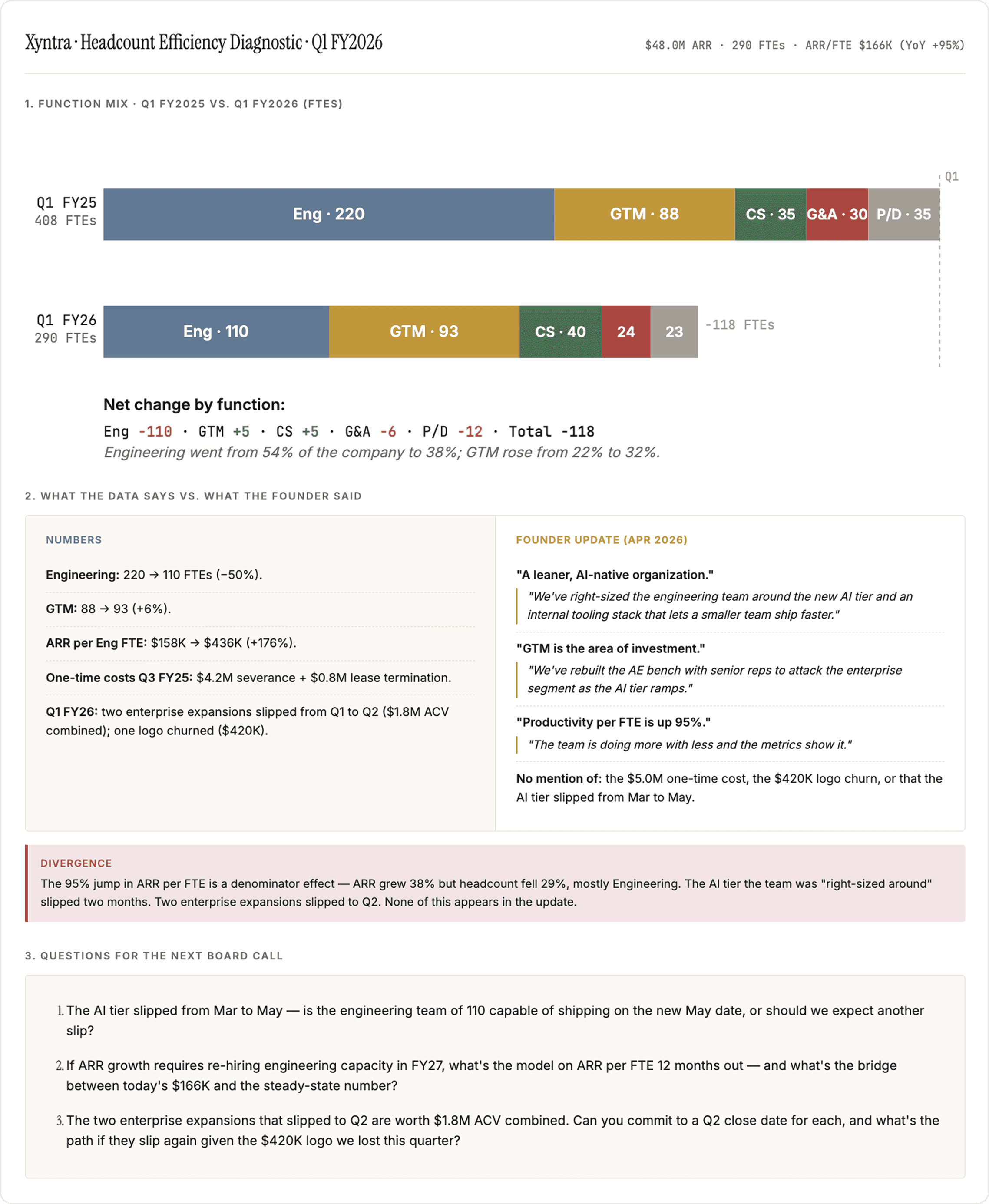
See a company that has seen a massive change in ARR per FTE? Time to dig deeper. The diagnostic: What is the team actually shipping?

Prepare your data
  • Five quarters of headcount split by function (Engineering, GTM, Customer Success, G&A, Product/Design)

  • Severance and one-time cost accruals from the financial statements

  • Two of the most recent CEO updates, board decks, and any restructuring memo from the period

Prompt

Build a single-company headcount efficiency diagnostic for [company name]. Four parts: 1. A function-mix comparison showing total FTEs by function (Engineering, GTM, Customer Success, G&A, Product/Design) for the start of the year vs. now. Bar widths should reflect absolute FTE counts so the total drop is visible, not just the proportions. 2. A two-column comparison: - Left column: what the structured data says (headcount changes by function, ARR per function FTE, severance accruals, any one-time costs). - Right column: what the founder said in the most recent CEO update — direct quotes where available. 3. A "Divergence" callout — what the data shows that the narrative does not address, or addresses in a misleading way. Be specific. If the founder's frame is "right-sizing for the AI tier," check whether the AI tier shipped on schedule and whether the function that was cut is the function that builds it. 4. Three questions for the next board call, grounded in the gap between numbers and narrative. Each question should be answerable with a yes/no or a number — not "tell me about culture." Output as a single artifact: function-mix at top, two-column data-vs-narrative in the middle, divergence callout, and questions at the bottom. Use the company's actual board materials and HRIS exports — not summaries.

Build a single-company headcount efficiency diagnostic for [company name]. Four parts: 1. A function-mix comparison showing total FTEs by function (Engineering, GTM, Customer Success, G&A, Product/Design) for the start of the year vs. now. Bar widths should reflect absolute FTE counts so the total drop is visible, not just the proportions. 2. A two-column comparison: - Left column: what the structured data says (headcount changes by function, ARR per function FTE, severance accruals, any one-time costs). - Right column: what the founder said in the most recent CEO update — direct quotes where available. 3. A "Divergence" callout — what the data shows that the narrative does not address, or addresses in a misleading way. Be specific. If the founder's frame is "right-sizing for the AI tier," check whether the AI tier shipped on schedule and whether the function that was cut is the function that builds it. 4. Three questions for the next board call, grounded in the gap between numbers and narrative. Each question should be answerable with a yes/no or a number — not "tell me about culture." Output as a single artifact: function-mix at top, two-column data-vs-narrative in the middle, divergence callout, and questions at the bottom. Use the company's actual board materials and HRIS exports — not summaries.

Copy prompt

Copied

Output
Headcount efficiency diagnostic comparing function mix changes across quarters

This analysis was one-shotted with Claude + PortfolioIQ MCP

This analysis was one-shotted with Claude + PortfolioIQ MCP

AI does great analysis, getting the data ready is the hard part

AI does great analysis, getting the data ready is the hard part

AI does great analysis, getting the data ready is the hard part

PortfolioIQ manages your data: extraction from documents, standardization, reconciliation across sources and human checks. Plugs latest, accruate data to wherever you do your work. Claude, ChatGPT, Excel or the PortfolioIQ platform.